AutoCAD engineering
Concept geometry, stage views and engineering drawings — a question turned into something you can inspect and measure. Fabrication readiness still requires validation.
The inner mitochondrial membrane holds the steepest voltage in the cell. Family B is built to fall into it.
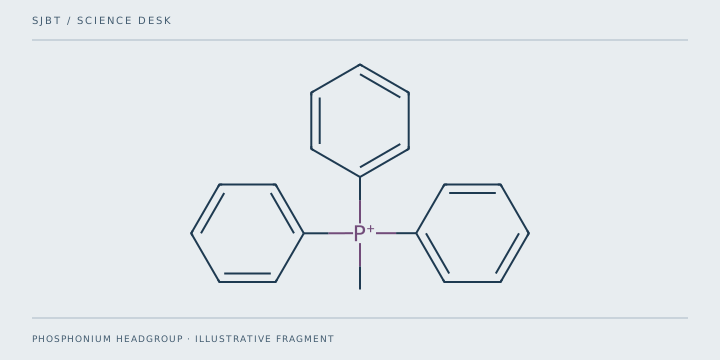
Roughly 70 millivolts across about 5 nanometres is on the order of 140,000 volts per centimetre. The inner mitochondrial membrane runs steeper still. A delocalised lipophilic cation — triphenylphosphonium is the worked example — accumulates across such a gradient by electrophoresis, not by binding anything. It is pulled.
Many tumour mitochondria are reported to be hyperpolarised relative to normal tissue. If that holds for a given line, a cation accumulates there preferentially because of the voltage, with no receptor in the story at all. Four compounds are deposited in this family.
This is the same quantity the unrelated agents converge on. Peter Mitchell's 1978 Nobel work established that the proton-motive force resolves into an electrical term and a pH term, interconvertibly. Moving protons is moving charge. Voltage and acidity are one quantity wearing two coats — which is why a wormer, an antimalarial, a gold arthritis salt and baking soda can land on the same effect without sharing a pharmacophore.
Accumulation should track membrane potential. Depolarise the mitochondria with an uncoupler and the effect should weaken in proportion. If activity is indifferent to the potential, the voltage story is wrong for that compound and we would say so.
| ARF ID | Name | Formula | MW | Status |
|---|---|---|---|---|
ARF-MOX-B1 | TPP pentanoate | C60H75NO9P+ | 985.23 | Computational design. Not synthesised, assayed or administered. |
ARF-MOX-B2 | TPP propanoate (short) | C58H71NO9P+ | 957.18 | Computational design. Not synthesised, assayed or administered. |
ARF-MOX-B3 | N-methylpyridinium butanoate | C47H65N2O9+ | 802.04 | Computational design. Not synthesised, assayed or administered. |
ARF-MOX-B4 | guanidinium hexanoate | C44H67N4O9+ | 796.04 | Computational design. Not synthesised, assayed or administered. |
Nothing above has been altered. The original listing of deposited voltage-door designs stands as published. What follows is appended.
The deposited lead, ARF-MOX-B1, hangs triphenylphosphonium off moxidectin through a
pentanoyl ester. It was nominated because a delocalised lipophilic cation accumulates in mitochondria
in proportion to membrane potential, and cancer mitochondria are hyperpolarised. Three objections were
raised: the cation does not distinguish tumour mitochondria from cardiac ones, accumulation is not
therapeutically controlled, and a permanent charge on a 985 Da scaffold at clogP 10.44 is a
protein-binding problem before it is anything else.
One decade of accumulation corresponds to 61.54 mV at body temperature. Hyperpolarisation to −180 mV therefore delivers about 842-fold enrichment, which comfortably clears the 110–220× exposure gap this chassis has to cross. But selectivity comes only from the difference between tumour and normal potential, and −180 mV against −140 mV gives 4.47×. The mechanism answers potency and supplies only a four- to five-fold voltage-derived margin. Off-target loading of the heart is therefore not a side risk to be engineered away; it is close to structural.
Two corrections to how we first said that, both of which we publish rather than quietly fix. A +1 species at electrochemical equilibrium has the same ideal voltage slope whatever its headgroup — “stronger cation” is not a Nernst parameter, and what headgroup substitution really changes is permeability, adsorption and binding. And uptake is voltage-dependent, so depolarisation damps further enrichment: “unregulated” was too strong as physics, and “no demonstrated control of normal-tissue exposure” is the honest form of the concern.
Score these designs on physicochemical grounds alone and neutral weak bases win: morpholine and dimethylamino conjugates reach clogP 6.0–6.9 at 711–837 Da with no ester and no unspecified centres, against the incumbent’s 10.44 at 985 Da. An external assessment duly nominated the morpholine ether as overall winner, on the reasoning that it protonates selectively in acidic tumour tissue while carrying no permanent systemic charge.
The physics does not support that. The mitochondrial matrix is relatively alkaline, and neutral-permeant, ion-impermeant weak-base trapping concentrates compounds in acidic compartments — principally lysosomes. For an assumed pKa of 6.5 or 7.0 the protonated fraction at pH 7.4 is 11.2% or 28.5%, and at pH 6.6 is 44.3% or 71.5%: incomplete gating, worth a total equilibrium ratio of only 1.59× or 2.51× — less selectivity than the voltage mechanism it replaces, aimed at the wrong organelle. No pKa has been measured for any of these molecules. They are basicity probes, not delivery systems, and a neutral weak base is not a better B1 — it is a different drug that scores well by abandoning the mechanism B1 exists to exploit.
A third proposal collapsed on inspection. Masking the charge with an arylboronate cleaved by peroxide does not work: oxidising an arylboronate to a phenol leaves a tetracoordinate phosphonium still positive. Nor does unmasking an already N-alkylated pyridinium remove a charge that was there all along. No conditional-cation design is admitted, and that gap is published as a gap.
Forty-five designs, twenty from Planet 44 and twenty-five from Planet 85, all
cross-verified. The deposited lead is retired, on reasoning rather than on evidence,
because no evidence exists. First three to make: B15 and B14, a matched
triethylphosphonium pair separating headgroup permeability from linkage chemistry, and
B25, a compact delocalised pyridinium — delocalised enough to cross a membrane,
far less greasy than three phenyl rings. B17 is the outlier: head logP −0.39 with
the permanent charge intact.
| ID | Series | Formula | MW | clogP | Charge | Status |
|---|---|---|---|---|---|---|
B17 | Planet 85 | C46H72N2O12P+ | 876.1 | 5.46 | +1 | Computational design. Not synthesised, assayed or administered. |
B19 | Planet 85 | C44H67N3O8 | 766.0 | 6.00 | +0 | Computational design. Not synthesised, assayed or administered. |
B18 | Planet 85 | C43H64N2O9 | 753.0 | 6.09 | +0 | Computational design. Not synthesised, assayed or administered. |
B21 | Planet 85 | C41H62N2O8 | 711.0 | 6.31 | +0 | Computational design. Not synthesised, assayed or administered. |
B13 | Planet 85 | C43H65N2O9+ | 754.0 | 6.38 | +1 | Computational design. Not synthesised, assayed or administered. |
B1o | Planet 44 | C47H72N4O9 | 837.1 | 6.49 | +0 | Computational design. Not synthesised, assayed or administered. |
B1m | Planet 44 | C46H69N3O10 | 824.1 | 6.58 | +0 | Computational design. Not synthesised, assayed or administered. |
B22 | Planet 85 | C42H59N3O8 | 733.9 | 6.65 | +0 | Computational design. Not synthesised, assayed or administered. |
B11 | Planet 85 | C45H61N2O9+ | 774.0 | 6.66 | +1 | Computational design. Not synthesised, assayed or administered. |
B25 | Planet 85 | C44H61N2O8+ | 746.0 | 6.74 | +1 | Computational design. Not synthesised, assayed or administered. |
B1p | Planet 44 | C44H67N3O9 | 782.0 | 6.80 | +0 | Computational design. Not synthesised, assayed or administered. |
B1n | Planet 44 | C45H68N2O9 | 781.0 | 6.87 | +0 | Computational design. Not synthesised, assayed or administered. |
B1h | Planet 44 | C45H70N3O9+ | 797.1 | 6.95 | +1 | Computational design. Not synthesised, assayed or administered. |
B1q | Planet 44 | C43H66N2O8 | 739.0 | 7.10 | +0 | Computational design. Not synthesised, assayed or administered. |
B1r | Planet 44 | C45H64N4O9 | 805.0 | 7.14 | +0 | Computational design. Not synthesised, assayed or administered. |
B1i | Planet 44 | C44H69N2O8+ | 754.0 | 7.24 | +1 | Computational design. Not synthesised, assayed or administered. |
B1j | Planet 44 | C48H68N3O9+ | 831.1 | 7.31 | +1 | Computational design. Not synthesised, assayed or administered. |
B1s | Planet 44 | C47H71N3O9 | 822.1 | 7.73 | +0 | Computational design. Not synthesised, assayed or administered. |
B12 | Planet 85 | C49H63N2O9+ | 824.0 | 7.81 | +1 | Computational design. Not synthesised, assayed or administered. |
B20 | Planet 85 | C46H70N2O8 | 779.1 | 7.88 | +0 | Computational design. Not synthesised, assayed or administered. |
B1t | Planet 44 | C46H70N2O8 | 779.1 | 8.02 | +0 | Computational design. Not synthesised, assayed or administered. |
B14 | Planet 85 | C46H72N2O9P+ | 828.1 | 8.54 | +1 | Computational design. Not synthesised, assayed or administered. |
B24 | Planet 85 | C59H73N3O10P+ | 1015.2 | 8.56 | +1 | Computational design. Not synthesised, assayed or administered. |
B1k | Planet 44 | C46H71NO9P+ | 813.0 | 8.75 | +1 | Computational design. Not synthesised, assayed or administered. |
B01 | Planet 85 | C46H71NO9P+ | 813.0 | 8.75 | +1 | Computational design. Not synthesised, assayed or administered. |
B10 | Planet 85 | C59H72N2O10P+ | 1000.2 | 8.76 | +1 | Computational design. Not synthesised, assayed or administered. |
B15 | Planet 85 | C45H71NO8P+ | 785.0 | 8.83 | +1 | Computational design. Not synthesised, assayed or administered. |
B02 | Planet 85 | C47H73NO9P+ | 827.1 | 9.14 | +1 | Computational design. Not synthesised, assayed or administered. |
B1f | Planet 44 | C48H76N2O9P+ | 856.1 | 9.32 | +1 | Computational design. Not synthesised, assayed or administered. |
B03 | Planet 85 | C48H75NO9P+ | 841.1 | 9.53 | +1 | Computational design. Not synthesised, assayed or administered. |
B1g | Planet 44 | C47H75NO8P+ | 813.1 | 9.61 | +1 | Computational design. Not synthesised, assayed or administered. |
B09 | Planet 85 | C61H77NO12P+ | 1047.3 | 9.69 | +1 | Computational design. Not synthesised, assayed or administered. |
B23 | Planet 85 | C57H71NO8P+ | 929.2 | 9.75 | +1 | Computational design. Not synthesised, assayed or administered. |
B16 | Planet 85 | C59H75NO9P+ | 973.2 | 9.76 | +1 | Computational design. Not synthesised, assayed or administered. |
B04 | Planet 85 | C49H77NO9P+ | 855.1 | 9.92 | +1 | Computational design. Not synthesised, assayed or administered. |
B1b | Planet 44 | C60H76N2O9P+ | 1000.2 | 10.24 | +1 | Computational design. Not synthesised, assayed or administered. |
B1d | Planet 44 | C63H82N2O12P+ | 1090.3 | 10.26 | +1 | Computational design. Not synthesised, assayed or administered. |
B1l | Planet 44 | C50H79NO9P+ | 869.2 | 10.31 | +1 | Computational design. Not synthesised, assayed or administered. |
B05 | Planet 85 | C50H79NO9P+ | 869.2 | 10.31 | +1 | Computational design. Not synthesised, assayed or administered. |
B1c | Planet 44 | C59H75NO8P+ | 957.2 | 10.53 | +1 | Computational design. Not synthesised, assayed or administered. |
B06 | Planet 85 | C51H81NO9P+ | 883.2 | 10.70 | +1 | Computational design. Not synthesised, assayed or administered. |
B07 | Planet 85 | C52H83NO9P+ | 897.2 | 11.09 | +1 | Computational design. Not synthesised, assayed or administered. |
B08 | Planet 85 | C52H83NO9P+ | 897.2 | 11.09 | +1 | Computational design. Not synthesised, assayed or administered. |
B1e | Planet 44 | C54H88N2O9P+ | 940.3 | 11.66 | +1 | Computational design. Not synthesised, assayed or administered. |
Published designs, not medicines. Every property is computed. Nothing in either branch has been synthesised, assayed or administered, and no compound has biological data of any kind.
One discipline runs underneath all of it: computational engineering — designing the thing completely, and proving out what you can, before anyone cuts metal or runs a reaction. It is the same craft whether the object is a bracket or a molecule. Only the units change.
Concept geometry, stage views and engineering drawings — a question turned into something you can inspect and measure. Fabrication readiness still requires validation.
The lattice between the two worlds: geometry that has to obey physics before it is worth costing, let alone building.
The same discipline applied to chemistry — scaffolds, conjugates and the design rationale for why a given structure should be made before anyone makes it.
Every structure parsed, sanitised and reported with its computed property set: isomeric SMILES, mass, lipophilicity, polar surface area, stereocentres. Computed, never quoted.
Our intention is plain: to own this field — computational engineering from the drawing to the molecule. Not by holding patents, but by being the group that does the work in the open, publishes its own corrections, and is the best in the world at deciding what is worth building next.
Computational designs only. Nothing described here has been synthesised, assayed or administered, and every property is a computed descriptor rather than a measurement. Fabrication and clinical readiness require validation that happens outside this factory.