AutoCAD engineering
Concept geometry, stage views and engineering drawings — a question turned into something you can inspect and measure. Fabrication readiness still requires validation.
An approved, cheap, off-patent drug kills glioma cells in three independent laboratories. Nobody has registered a human cancer trial.
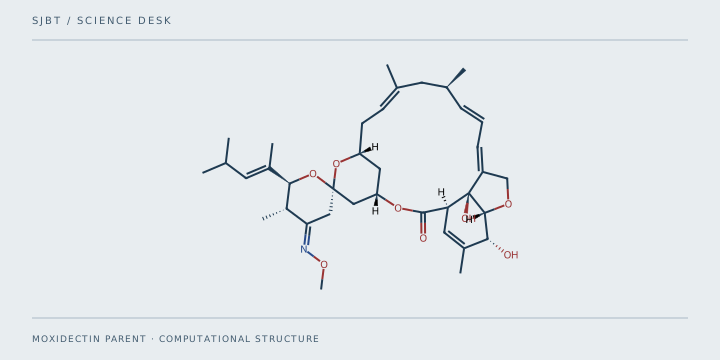
Song and colleagues, Oncology Reports, 2018: moxidectin inhibits glioma cell viability by inducing G0/G1 arrest and apoptosis — and they noted no earlier study had examined moxidectin for cancer at all. Liu and colleagues, Journal of Cancer, 2020: cytostatic autophagic cell death via AKT/mTOR inhibition. Kaushik and colleagues, Molecular Cancer Therapeutics, August 2025: the Hippo-YAP pathway in glioblastoma, with tumour suppression in an intracranial mouse model. All three verified against NCBI.
Terminal half-life of roughly eighteen to twenty-three days against ivermectin's eighteen hours. Better tissue partitioning. A poor substrate for the efflux pump that limits how much drug a cell can hold. FDA-approved for human use since 2018, WHO-listed, off patent, manufactured worldwide, cheap.
This piece nearly carried a better-sounding and false line: one laboratory, two papers, eight years of silence. It did not survive a search — a third group had picked the question up. The correction is published on the original articles rather than quietly fixed, because a project demanding that institutions follow overlooked evidence has to notice evidence that interrupts its own argument.
A search of ClinicalTrials.gov for moxidectin as an intervention returns studies, none with an oncology indication. We state that precisely: we did not identify a registered human cancer trial. Who is assessing whether these findings merit a translational programme, what did they find, and where can anyone inspect it?
One discipline runs underneath all of it: computational engineering — designing the thing completely, and proving out what you can, before anyone cuts metal or runs a reaction. It is the same craft whether the object is a bracket or a molecule. Only the units change.
Concept geometry, stage views and engineering drawings — a question turned into something you can inspect and measure. Fabrication readiness still requires validation.
The lattice between the two worlds: geometry that has to obey physics before it is worth costing, let alone building.
The same discipline applied to chemistry — scaffolds, conjugates and the design rationale for why a given structure should be made before anyone makes it.
Every structure parsed, sanitised and reported with its computed property set: isomeric SMILES, mass, lipophilicity, polar surface area, stereocentres. Computed, never quoted.
Our intention is plain: to own this field — computational engineering from the drawing to the molecule. Not by holding patents, but by being the group that does the work in the open, publishes its own corrections, and is the best in the world at deciding what is worth building next.
Computational designs only. Nothing described here has been synthesised, assayed or administered, and every property is a computed descriptor rather than a measurement. Fabrication and clinical readiness require validation that happens outside this factory.