AutoCAD engineering
Concept geometry, stage views and engineering drawings — a question turned into something you can inspect and measure. Fabrication readiness still requires validation.
A tumour cell eats more glucose than it needs. Family A asks whether that appetite can be used as an address label.
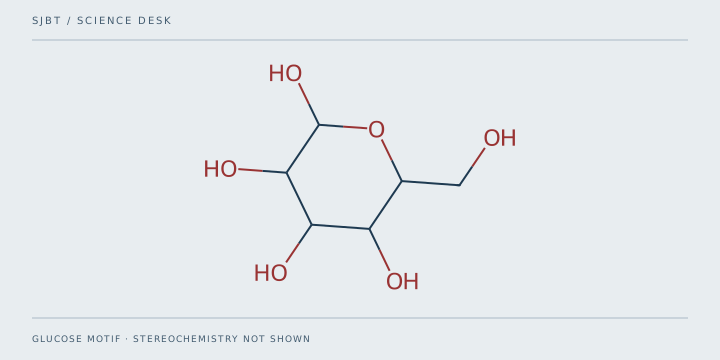
The Warburg effect is a century old and uncontroversial: many tumour cells run glycolysis hard even when oxygen is plentiful, and they upregulate glucose transporters to feed it. That is not a vulnerability by itself. It is an address — a surface feature more common on the cells you want to reach than on the ones you do not.
Family A attaches a carbohydrate handle to a parent scaffold through a cleavable linker. The intent is that transporter-mediated uptake does the targeting and the linker releases the parent inside. Four compounds are deposited in this family, each a different handle or linker chemistry against the same parent.
The transporter biology is published. The parent compounds' anticancer activity in vitro is published. The conjugates are designs. None has been synthesised, and the assumption that a glycoconjugate is taken up intact and cleaved usefully is exactly the assumption a first experiment exists to break.
Glycoconjugation can simply abolish activity — a handle in the wrong place kills the pharmacophore. It can also be cleaved in serum long before it reaches anything. Both outcomes are cheap to detect and would be reported here.
| ARF ID | Name | Formula | MW | Status |
|---|---|---|---|---|
ARF-MOX-A1 | glucosyl succinate (GLUT import) | C47H67NO16 | 902.04 | Computational design. Not synthesised, assayed or administered. |
ARF-MOX-A2 | 2-deoxyglucosyl succinate | C47H67NO15 | 886.05 | Computational design. Not synthesised, assayed or administered. |
ARF-MOX-A3 | GlcNAc succinate | C49H70N2O16 | 943.10 | Computational design. Not synthesised, assayed or administered. |
ARF-MOX-A4 | glucuronyl carbamate | C45H64N2O15 | 873.01 | Computational design. Not synthesised, assayed or administered. |
One discipline runs underneath all of it: computational engineering — designing the thing completely, and proving out what you can, before anyone cuts metal or runs a reaction. It is the same craft whether the object is a bracket or a molecule. Only the units change.
Concept geometry, stage views and engineering drawings — a question turned into something you can inspect and measure. Fabrication readiness still requires validation.
The lattice between the two worlds: geometry that has to obey physics before it is worth costing, let alone building.
The same discipline applied to chemistry — scaffolds, conjugates and the design rationale for why a given structure should be made before anyone makes it.
Every structure parsed, sanitised and reported with its computed property set: isomeric SMILES, mass, lipophilicity, polar surface area, stereocentres. Computed, never quoted.
Our intention is plain: to own this field — computational engineering from the drawing to the molecule. Not by holding patents, but by being the group that does the work in the open, publishes its own corrections, and is the best in the world at deciding what is worth building next.
Computational designs only. Nothing described here has been synthesised, assayed or administered, and every property is a computed descriptor rather than a measurement. Fabrication and clinical readiness require validation that happens outside this factory.